


Buildings. Berlin
3,000 Days
After three thousand days we stopped loving.
It left quietly, before the first blue in the sky,
while one could still see stars and long shadows.
It walked barefoot across the moonlit floor admiring its feet,
holding a pair of shoes in one hand and an old toothbrush in the other.
It tried to look back but the thought of salt was too great. When it
reached the door,
it shut its eyes going back to minutes prior, with you in bed and your
quiet breath.
It tried to memorize your lashes and the creases in your lips, each
a mini-wrinkle.
It wanted more time but knew that more time was not an option.
It did not close the door entirely for fear of making noise, so
that forever
after we stopped loving, everything was framed in the sullen violet
of almost morning. Almost something that was not enough.
by Erika Moya
Erika Moya is a painter and writer. Her work has appeared in Qaartsiluni, the Smoking Poet, the Holly Rose Review, SN Review, the Toronto Quarterly, and Mosaic: Art and Literary journal of the University of California, Riverside. She attends the MFA program of the University of North Carolina Wilmington.


maria
Catalan version:
Mireu-me els ulls
Mireu-me els ulls per creure
en el demà que teniu als dits,
sense llum
dels meus ulls clars
no hi haurà per ningú
cap demà.
Penseu en mi per créixer
en l’esperança d’uns anys millors,
la llibertat
que ens heu negat
brilla al fons dels meus ulls
encisats.
Sols el poder us tempta
i pel poder us veneu el cor,
però la clau d’or
del temps que fuig
la tinc jo i és la veu
del futur.
Mireu-me els ulls per créixer… per créixer…
English version:
Look at my eyes to believe
in the morning you have fingers,
no light
my eyes clear
there will be no one to
no tomorrow.
Consider me to grow
in the hope of better years,
freedom
we have denied
shines in the background of my eyes
enchanted.
Only the power tempts you
and will sell power to the heart,
but the golden key
time flees
I have it and it is the voice
the future.
Look at my eyes to grow … to grow …
Miquel Martí i Pol (March 19, 1929 – November 11, 2003)
was one of the most popular poets from Catalunya (Europe) in the 20th century.


Maria

María
Yo no quiero más luz que tu cuerpo ante el mío
Yo no quiero más luz que tu cuerpo ante el mío:
claridad absoluta, transparencia redonda.
Limpidez cuya extraña, como el fondo del río,
con el tiempo se afirma, con la sangre se ahonda..
¿Qué lucientes materias duraderas te han hecho,
corazón de alborada, carnación matutina?
Yo no quiero más día que el que exhala tu pecho.
Tu sangre es la mañana que jamás se termina.
No hay más luz que tu cuerpo, no hay más sol: todo ocaso.
Yo no veo las cosas a otra luz que tu frente.
La otra luz es fantasma, nada más, de tu paso.
Tu insondable mirada nunca gira al poniente.
Claridad sin posible declinar. Suma esencia
del fulgor que ni cede ni abandona la cumbre.
Juventud. Limpidez. Claridad. Transparencia
acercando los astros más lejanos de lumbre.
Claro cuerpo moreno de calor fecundante.
Hierba negra el origen; hierba negra las sienes.
Trago negro los ojos, la mirada distante.
Día azul. Noche clara. Sombra clara que vienes.
Yo no quiero más luz que tu sombra dorada
donde brotan anillos de una hierba sombría.
En mi sangre, fielmente por tu cuerpo abrasada,
para siempre es de noche: para siempre es de día.
Miguel Hernández (October 30, 1910-March 28, 1942), born in Orihuela (Alicante Province), was a leading 20th century Spanish poet and playwright.


Julia
Here I Am … by Charles Bukowski
drunk again at 3 a.m. at the end of my 2nd bottle
of wine, I have typed from a dozen to 15 pages of
poesy
an old man
maddened for the flesh of young girls in this
dwindling twilight
liver gone
kidneys going
pancrea pooped
top-floor blood pressure
while all the fear of the wasted years
laughs between my toes
no woman will live with me
no Florence Nightingale to watch the
Johnny Carson show with
if I have a stroke I will lay here for six
days, my three cats hungrily ripping the flesh
from my elbows, wrists, head
the radio playing classical music …
I promised myself never to write old man poems
but this one’s funny, you see, excusable, be-
cause I’ve long gone past using myself and there’s
still more left
here at 3 a.m. I am going to take this sheet from
the typer
pour another glass and
insert
make love to the fresh new whiteness
maybe get lucky
again
first for
me
later
for you.
from “All’s Normal Here” – 1985
Henry Charles Bukowski (August 16, 1920 – March 9, 1994) was a German American poet, novelist, and short story writer
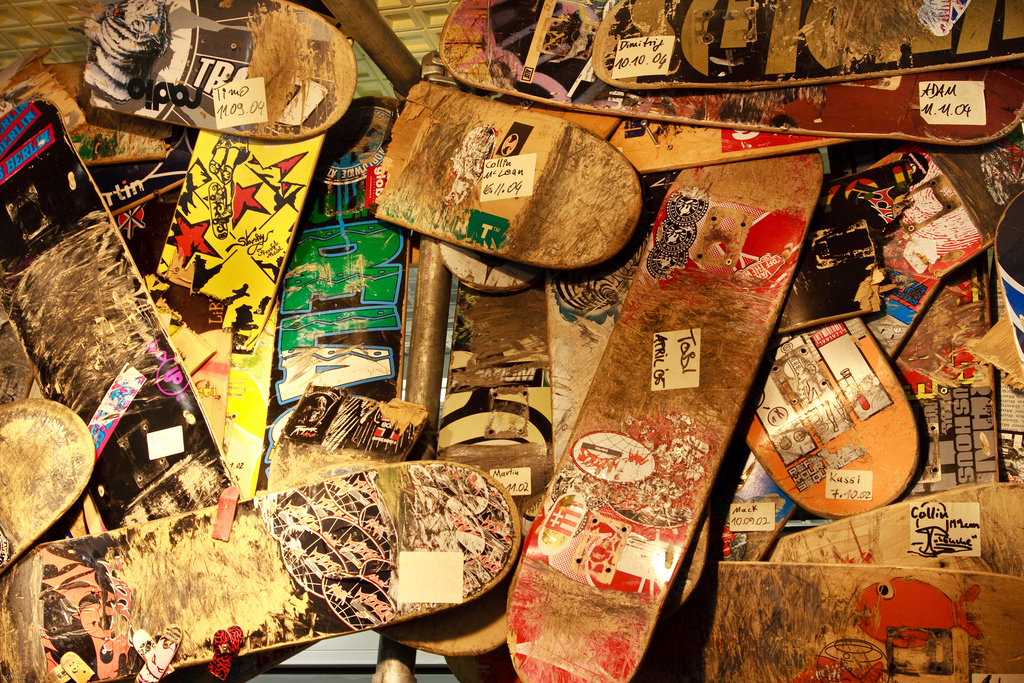
dead skates
(Via flickr.com.)
The 1940s-1960s
Skateboarding was probably born sometime in the late 1940s or early 1950s when surfers in California wanted something to surf when the waves were flat. No one knows who made the first board, rather, it seems that several people came up with similar ideas at around the same time. These first skateboarders started with wooden boxes or boards with roller skate wheels attached to the bottom. The boxes turned into planks, and eventually companies were producing decks of pressed layers of wood — similar to the skateboard decks of today. During this time, skateboarding was seen as something to do for fun besides surfing, and was therefore often referred to as “Sidewalk Surfing”.
A skateboarder in Nice, France.
The first manufactured skateboards were ordered by a Los Angeles, California surf shop, meant to be used by surfers in their downtime. The shop owner, Bill Richard, made a deal with the Chicago Roller Skate Company to produce sets of skate wheels, which they attached to square wooden boards. Accordingly, skateboarding was originally denoted “sidewalk surfing” and early skaters emulated surfing style and maneuvers. Crate scooters preceded skateboards, and were borne of a similar concept, with the exception of having a wooden crate attached to the nose (front of the board), which formed rudimentary handlebars.
A number of surfing manufacturers such as Makaha started building skateboards that resembled small surfboards, and assembling teams to promote their products. The popularity of skateboarding at this time spawned a national magazine, Skateboarder Magazine, and the 1965 international championships were broadcast on national television. The growth of the sport during this period can also be seen in sales figures for Makaha, which quoted $10 million worth of board sales between 1963 and 1965 (Weyland, 2002:28). Yet by 1966 the sales had dropped significantly (ibid) and Skateboarder Magazine had stopped publication. The popularity of skateboarding dropped and remained low until the early 1970s…
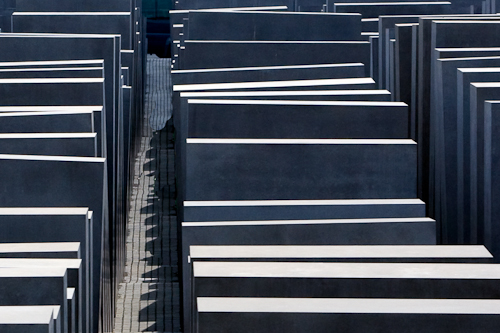

The Holocaust Memorial Museum. Berlin
Death is not the end
Death can never be the end.
Death is the road.
Life is the traveller.
The Soul is the Guide
…
Our mind thinks of death.
Our heart thinks of life
Our soul thinks of Immortality.
Sri Chinmoy
Chinmoy Kumar Ghose (August 27, 1931 – October 11, 2007) was an Indian spiritual teacher and philosopher who emigrated to the U.S. in 1964. An author, composer, artist and athlete, he was perhaps best known for holding public events on the theme of inner peaceand world harmony (such as concerts, meditations, and races). His teachings emphasize love for God, daily meditation on the heart, service to the world, and religious tolerance (a view that “all faiths” are essentially divine).


from the sky
I want you to know
one thing.
You know how this is:
if I look
at the crystal moon, at the red branch
of the slow autumn at my window,
if I touch
near the fire
the impalpable ash
or the wrinkled body of the log,
everything carries me to you,
as if everything that exists,
aromas, light, metals,
were little boats
that sail
toward those isles of yours that wait for me.
Well, now,
if little by little you stop loving me
I shall stop loving you little by little.

Françoise
If suddenly
you forget me
do not look for me,
for I shall already have forgotten you.
If you think it long and mad,
the wind of banners
that passes through my life,
and you decide
to leave me at the shore
of the heart where I have roots,
remember
that on that day,
at that hour,
I shall lift my arms
and my roots will set off
to seek another land.
But
if each day,
each hour,
you feel that you are destined for me
with implacable sweetness,
if each day a flower
climbs up to your lips to seek me,
ah my love, ah my own,
in me all that fire is repeated,
in me nothing is extinguished or forgotten,
my love feeds on your love, beloved,
and as long as you live it will be in your arms
without leaving mine
Pablo Neruda (July 12, 1904 – September 23, 1973) was born in Parral, Chile.
Considered one of the greatest and most influential poets of the 20th century.
![Are you drinking? [by Charles Bukowski]](https://bclphoto.net/wp-content/uploads/2009/08/bcl0907143311-2-editar-editar-e1433789589325.jpg?w=1500)
![Are you drinking? [by Charles Bukowski]](https://bclphoto.net/wp-content/uploads/2009/08/bcl0907143311-2-editar-editar.jpg)
Are you drinking? [by Charles Bukowski]
 Are you drinking? [by Charles Bukowski]

washed-up, on shore, the old yellow notebook
out again
I write from the bed
as I did last
year.
will see the doctor,
Monday.
“yes, doctor, weak legs, vertigo, head-
aches and my back
hurts.”
“are you drinking?” he will ask.
“are you getting your
exercise, your
vitamins?”
I think that I am just ill
with life, the same stale yet
fluctuating
factors.
even at the track
I watch the horses run by
and it seems
meaningless.
I leave early after buying tickets on the
remaining races.
“taking off?” asks the motel
clerk.
“yes, it’s boring,”

looking forward
I tell him.
“If you think it’s boring
out there,” he tells me, “you oughta be
back here.”
so here I am
propped up against my pillows
again
just an old guy
just an old writer
with a yellow
notebook.
something is
walking across the
floor
toward
me.
oh, it’s just
my cat
this
time.
Henry Charles Bukowski (August 16, 1920 – March 9, 1994) was a German American poet, novelist, and short story writer.


















 bCL Photography