

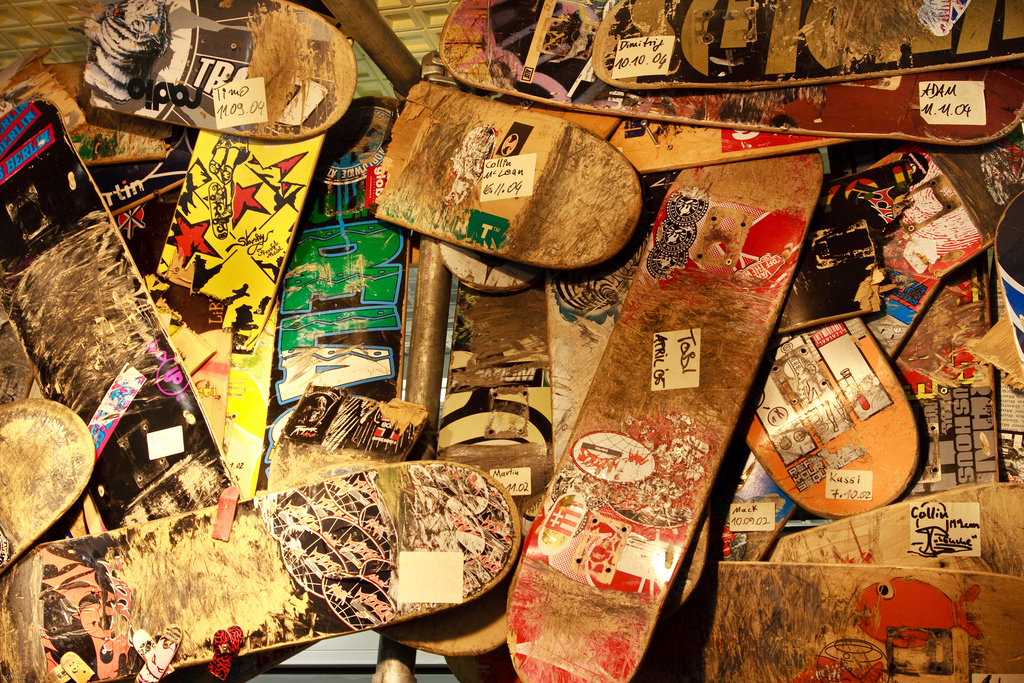
dead skates
(Via flickr.com.)
The 1940s-1960s
Skateboarding was probably born sometime in the late 1940s or early 1950s when surfers in California wanted something to surf when the waves were flat. No one knows who made the first board, rather, it seems that several people came up with similar ideas at around the same time. These first skateboarders started with wooden boxes or boards with roller skate wheels attached to the bottom. The boxes turned into planks, and eventually companies were producing decks of pressed layers of wood — similar to the skateboard decks of today. During this time, skateboarding was seen as something to do for fun besides surfing, and was therefore often referred to as “Sidewalk Surfing”.
A skateboarder in Nice, France.
The first manufactured skateboards were ordered by a Los Angeles, California surf shop, meant to be used by surfers in their downtime. The shop owner, Bill Richard, made a deal with the Chicago Roller Skate Company to produce sets of skate wheels, which they attached to square wooden boards. Accordingly, skateboarding was originally denoted “sidewalk surfing” and early skaters emulated surfing style and maneuvers. Crate scooters preceded skateboards, and were borne of a similar concept, with the exception of having a wooden crate attached to the nose (front of the board), which formed rudimentary handlebars.
A number of surfing manufacturers such as Makaha started building skateboards that resembled small surfboards, and assembling teams to promote their products. The popularity of skateboarding at this time spawned a national magazine, Skateboarder Magazine, and the 1965 international championships were broadcast on national television. The growth of the sport during this period can also be seen in sales figures for Makaha, which quoted $10 million worth of board sales between 1963 and 1965 (Weyland, 2002:28). Yet by 1966 the sales had dropped significantly (ibid) and Skateboarder Magazine had stopped publication. The popularity of skateboarding dropped and remained low until the early 1970s…


The Holocaust Memorial Museum. Berlin
Death is not the end
Death can never be the end.
Death is the road.
Life is the traveller.
The Soul is the Guide
…
Our mind thinks of death.
Our heart thinks of life
Our soul thinks of Immortality.
Sri Chinmoy
Chinmoy Kumar Ghose (August 27, 1931 – October 11, 2007) was an Indian spiritual teacher and philosopher who emigrated to the U.S. in 1964. An author, composer, artist and athlete, he was perhaps best known for holding public events on the theme of inner peaceand world harmony (such as concerts, meditations, and races). His teachings emphasize love for God, daily meditation on the heart, service to the world, and religious tolerance (a view that “all faiths” are essentially divine).


from the sky
I want you to know
one thing.
You know how this is:
if I look
at the crystal moon, at the red branch
of the slow autumn at my window,
if I touch
near the fire
the impalpable ash
or the wrinkled body of the log,
everything carries me to you,
as if everything that exists,
aromas, light, metals,
were little boats
that sail
toward those isles of yours that wait for me.
Well, now,
if little by little you stop loving me
I shall stop loving you little by little.

Françoise
If suddenly
you forget me
do not look for me,
for I shall already have forgotten you.
If you think it long and mad,
the wind of banners
that passes through my life,
and you decide
to leave me at the shore
of the heart where I have roots,
remember
that on that day,
at that hour,
I shall lift my arms
and my roots will set off
to seek another land.
But
if each day,
each hour,
you feel that you are destined for me
with implacable sweetness,
if each day a flower
climbs up to your lips to seek me,
ah my love, ah my own,
in me all that fire is repeated,
in me nothing is extinguished or forgotten,
my love feeds on your love, beloved,
and as long as you live it will be in your arms
without leaving mine
Pablo Neruda (July 12, 1904 – September 23, 1973) was born in Parral, Chile.
Considered one of the greatest and most influential poets of the 20th century.
![Are you drinking? [by Charles Bukowski]](https://bclphoto.net/wp-content/uploads/2009/08/bcl0907143311-2-editar-editar-e1433789589325.jpg?w=1500)
![Are you drinking? [by Charles Bukowski]](https://bclphoto.net/wp-content/uploads/2009/08/bcl0907143311-2-editar-editar.jpg)
Are you drinking? [by Charles Bukowski]
 Are you drinking? [by Charles Bukowski]

washed-up, on shore, the old yellow notebook
out again
I write from the bed
as I did last
year.
will see the doctor,
Monday.
“yes, doctor, weak legs, vertigo, head-
aches and my back
hurts.”
“are you drinking?” he will ask.
“are you getting your
exercise, your
vitamins?”
I think that I am just ill
with life, the same stale yet
fluctuating
factors.
even at the track
I watch the horses run by
and it seems
meaningless.
I leave early after buying tickets on the
remaining races.
“taking off?” asks the motel
clerk.
“yes, it’s boring,”

looking forward
I tell him.
“If you think it’s boring
out there,” he tells me, “you oughta be
back here.”
so here I am
propped up against my pillows
again
just an old guy
just an old writer
with a yellow
notebook.
something is
walking across the
floor
toward
me.
oh, it’s just
my cat
this
time.
Henry Charles Bukowski (August 16, 1920 – March 9, 1994) was a German American poet, novelist, and short story writer.

















 bCL Photography